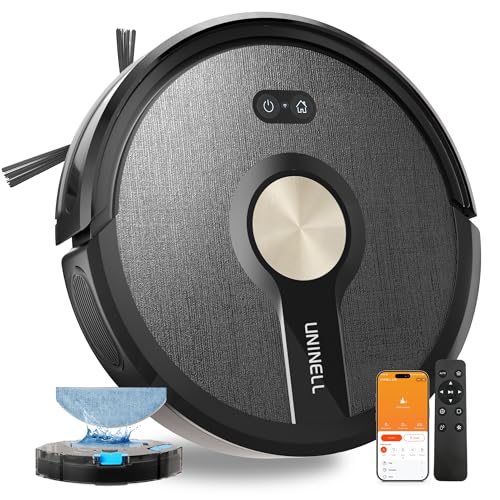
uninell UR1 Robot Vacuum Cleaner With Mop
A budget robot vacuum and mop, offering 5,000 Pa of suction and up to 180 minutes of run time.
A self-emptying dock is one of the priciest robot vacuum upgrades, so it is worth knowing what it really adds. This guide compares self-empty and manual-empty robots on convenience, cost and upkeep.
A self-empty dock is worth it if you want truly hands-off cleaning and do not want to empty a small bin every clean - it tips the dust into a larger bag for weeks at a time. A manual-empty robot is cheaper and perfectly fine if you do not mind emptying it regularly and want to save money or avoid buying dust bags.
After each clean, the robot returns to its dock, which sucks the contents of its small onboard bin into a much larger bag in the base. That means you only deal with emptying every few weeks rather than after every run, and you handle dust far less - useful for allergy sufferers and anyone who wants to forget about the robot.
Self-empty docks add cost upfront, take up more space, and need replacement dust bags as an ongoing expense. They can also be a little noisy during the empty cycle. None of these is a dealbreaker, but they are real trade-offs against the big gain in convenience, so weigh them against how much the hands-off running is worth to you.
If you have a smaller home, do not mind a quick daily empty, or want to keep the price and running costs down, a manual-empty robot does the same cleaning. The onboard bin is small, so you empty it more often, but there are no dust bags to buy. For many single-room or budget setups this is the sensible choice.
Self-empty suits larger homes, pet owners, allergy sufferers and anyone who wants to truly forget about the robot for weeks. The convenience and reduced dust exposure justify the cost for them. If you are happy to empty a small bin regularly and want to save money, stick with a manual-empty model.
| # | Model | Suction | Run time | Navigation | Mop | Self-empty |
|---|---|---|---|---|---|---|
| 1 | uninell UR1 Robot Vacuum Cleaner With Mop | 5,000 Pa | 180 min | Gyroscope | Yes | - |
| 2 | Monsga MS1 MAX Robot Vacuum With Mop | 7,000 Pa | 180 min | LiDAR | Yes | Yes |
| 3 | Vexilar Cleanova W9 Robot Vacuum Cleaner With Mop | 10,000 Pa | 150 min | LiDAR | Yes | - |
| 4 | Tapo RV20 Max Plus Robot Vacuum and Mop | 5,300 Pa | - | LiDAR | Yes | Yes |
| 5 | Ultenic T20 Pro Self Emptying Robot Vacuum Cleaner With Mop | 8,000 Pa | 180 min | LiDAR | Yes | Yes |
| 6 | Vexilar W15 Robot Vacuum and Mop | 10,000 Pa | 180 min | LiDAR | Yes | Yes |
Specs from each manufacturer's Amazon UK listing, checked 2026-11-09.
A budget robot vacuum and mop, offering 5,000 Pa of suction and up to 180 minutes of run time.

A mid-range robot vacuum and mop with a self-emptying dock, offering 7,000 Pa of suction, LiDAR navigation and up to 180 minutes of run time.

A budget robot vacuum and mop, offering 10,000 Pa of suction, LiDAR navigation and up to 150 minutes of run time.

A budget robot vacuum and mop with a self-emptying dock, offering 5,300 Pa of suction and LiDAR navigation.

A budget robot vacuum and mop with a self-emptying dock, offering 8,000 Pa of suction, LiDAR navigation and up to 180 minutes of run time.

A mid-range robot vacuum and mop with a self-emptying dock, offering 10,000 Pa of suction, LiDAR navigation and up to 180 minutes of run time.
If you want truly hands-off cleaning for weeks and less dust exposure, yes - the dock tips the bin into a larger bag automatically. If you have a small home and do not mind emptying regularly, a manual model saves money.
A little - they need replacement dust bags, which is an ongoing cost manual-empty robots avoid. The trade-off is far less frequent emptying and reduced dust exposure, which many people find well worth it.
Typically every few weeks rather than after each clean, depending on the dock bag size and how much your floors collect. It is far less often than a manual-empty robot, whose smaller bin needs emptying regularly.
Our top pick is the uninell UR1 Robot Vacuum Cleaner With Mop (our score 9.6/10) - a budget robot vacuum and mop, offering 5,000 Pa of suction and up to 180 minutes of run time.