

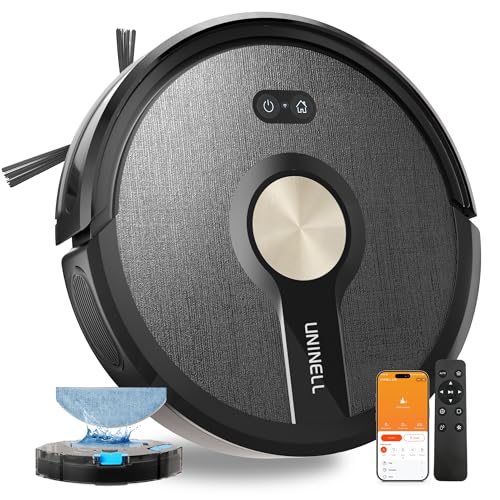
uninell UR1 Robot Vacuum Cleaner With Mop
Best for hard-floored homes that want vacuuming and light mopping.
We compare the Roborock Q10 S5 Robot Vacuum Cleaner With Mop and the Ultenic T20 Pro Self Emptying Robot Vacuum Cleaner With Mop across every dimension that matters - our scores, the key specs, and how each performs on the things you will actually notice day to day.
| Roborock Q10 S5 Robot Vacuum Cleaner With Mop | Ultenic T20 Pro Self Emptying Robot Vacuum Cleaner With Mop | |
|---|---|---|
| Our score | 7.3/10 | 9.3/10 |
| Best for | Homes wanting hands-off floor cleaning on hard floors and carpet, with mopping | homes with hard floors that want vacuuming and mopping with little upkeep, and multi-room homes where room-by-room mapping helps |
| Not ideal for | Homes with lots of floor clutter, cables or deep high-pile carpet, where a robot struggles | small flats with little floor space for a large dock |
| Brand | Roborock | Ultenic |
How well a robot lifts dirt depends heavily on its suction capability. This robot vacuum is rated at 10,000 Pa HyperForce suction, which is designed to lift pet hair, dust and debris from floor crevices and from deep within carpets. Cleaning is supported by dual anti-tangle brushes, including a JawScrapers Comb main brush and an anti-tangle side brush that helps reduce hair wrap. On mixed floors, the VibraRise 2.0 vibrating mop system targets stubborn stains, while the auto-lifting mopping system raises the mop when carpet is detected. Suction strength is clear, but fine results also depend on brush access and floor conditions.
The Ultenic is rated at up to 8,000 Pa of suction on its strongest setting, enough for everyday dust, crumbs and pet hair on low-pile carpet.
Navigation and mapping are handled by a LiDAR system, enabling the roborock Q10 S5 to plan routes rather than moving randomly. During cleaning, the LiDAR scans 360° and creates detailed maps, which supports efficient movement across rooms. The robot also remembers multiple maps for multiple floors, helping reduce time spent finding routes. It includes smart suggestions for No-Go Zones to avoid tricky areas such as under chairs and tables. Obstacle handling uses reactive technology, so cluttered layouts may still lead to minor detours.
The Ultenic uses LiDAR (laser) navigation to map your home, so it cleans in neat rows and lets you send it to one room or set no-go zones in the app.
Battery life and run time for the Roborock varies depending on how long it takes to complete a room, because the manufacturer does not state an exact run time or battery capacity. Run time is affected by floor type, obstacle density, and whether multiple maps or zones are used. The unit can still plan efficient routes using LiDAR navigation, which may reduce total travel time. For best results, shorter cleaning sessions can be used, then restarted as needed. The main limitation is the lack of published battery figures, so practical run time needs observation.
The Ultenic runs for up to 180 minutes on a charge (on its lowest power setting), so it can usually finish a large home in one go, and it returns to its dock to recharge.
The robot vacuum mop function uses a VibraRise 2.0 vibrating mop system to help lift stubborn stains and grime. It is also paired with an auto-lifting feature that adjusts when it detects carpet. This setup is designed to tackle tough dirt and grime by vibrating the mop as it cleans, and it can raise the mop automatically around carpet boundaries for safer mopping.
The Ultenic mops as well as vacuums, using a water tank and mop pad you rinse by hand.
With a self-emptying setup, the roborock Q10 S5 is designed to reduce how often a user needs to empty a bin during daily cleaning. For the Roborock (UK), maintenance still includes routine checks of the brush condition, especially where hair is present. The dual anti-tangle brushes, which use a JawScrapers Comb anti-tangle main brush and an anti-tangle side brush, should help limit tangles, but periodic inspection remains necessary.
Its self-emptying dock sucks the dust out of the robot after each run, so you rarely touch the dirt yourself.
Through its app, the robot vacuum supports map-based navigation, including remembering multiple maps for multiple floors. It also provides smart suggestions for no-go zones, such as under chairs and tables, to help reduce missed spots. Day-to-day operation typically follows planned routes, while obstacle avoidance uses structured light to navigate around clutter. The system supports only 2.4G Wi-Fi, which can limit compatibility for some homes.
The Ultenic is controlled from a phone app and works with voice assistants, so you can start, schedule or stop a clean from anywhere.
Noise level is a practical concern for anyone planning to run the Roborock Q10 S5 around work, sleep, or shared spaces, particularly because the robot uses structured light obstacle avoidance and follows mapped routes through the home. The manufacturer description does not specify decibel (dB) levels or any quiet-mode settings, so exact sound measurement is not available. Noise can also vary by cleaning task, because mopping uses a vibrating mop system and suction runs at the same time. For quieter evenings, schedule cleaning for times when background noise is already expected.
Noise level is an early consideration for day or night use, and this model is rated at 60dB during operation. The robot vacuum uk is designed to be quieter than most standard vacuums, which can help when working, sleeping or watching TV. Sound level depends on the selected cleaning mode, since suction and mop activity can affect how hard it runs. The auto-emptying docking station is included, although the stated 60dB rating applies during operation.
Pet hair performance on the Roborock is mainly driven by its suction power and anti-tangle brush setup, designed for everyday shedding on hard floors and in carpets. With 10,000 Pa HyperForce suction, the robot lifts pet hair, dust and debris, including from floor crevices and within carpets. The JawScrapers Comb anti-tangle main brush and anti-tangle side brush help reduce hair wrap, supporting more consistent pickup over time. For owners asking whether the robot vacuum is any good for pet hair, pet hair removal is a clear strength, though heavy buildup may still require repeated passes.
Pet hair performance is where the Ultenic's main claims show up, since the manufacturer states it uses 8000Pa of suction to lift embedded dust, pet hair, and debris from carpets, hard floors and tiles. Strong suction can help remove clumps along edges and in traffic areas, but results still depend on how long hair has been ground in. The robot also supports vacuum plus mop combinations, so light hair transfer may be reduced on hard floors. Buyers comparing the robot vacuum self-emptying robot vacuum cleaner with mop price should expect better pick-up than weaker suction units, though deep matting may require a manual pass.
Cleaning and maintenance on the Roborock are built around its dual-brush and mopping design, so day-to-day upkeep remains straightforward but does still require routine checks. The auto-lifting mopping system should be inspected after each mopping session, because fabric and debris can leave residue. The anti-tangle main brush and anti-tangle side brush need periodic cleaning, as hair and dust can build up in the brush edges. For debris control, the robot vacuum self-empty feature reduces how often the user handles dirt collection.
Cleaning and maintenance for this robot vacuum are focused on reducing day-to-day effort, mainly through its self-empty docking station and multi-mode operation. As an ultenic robot vacuum, it transfers dust into the station using a sealed, touch-free system, so there is less messy bin handling. The dock area should still be checked regularly, because full bins and water residue can reduce performance. The unit offers three modes - vacuum plus mopping, suction-only, and mop-only - with adjustable suction and water flow, helping tailor cleaning for carpet versus tile and limiting smearing. After mopping, the mop-related components should be rinsed and dried.
Who is the robot vacuum best suited for? The Roborock robot vacuum with mop is designed for homes that want both vacuuming and mopping in the same cleaning routine, particularly where pet hair, dust and debris build up in floor crevices and on carpets. The 10,000 Pa suction and dual anti-tangle brushes are built to tackle hair and threads that commonly lead to frequent clean-ups, although performance depends on floor type and the amount of clutter. LiDAR navigation supports multi-floor mapping, storing multiple maps for households with several levels. Reactive obstacle avoidance helps in busy rooms, though it may still miss very small hazards that are not clearly detectable.
The Ultenic is a good fit for households that want hands-free, day-to-day floor care, particularly when multiple floor types need attention, such as carpets, hard floors and tiles. It suits busy homes that prefer the docking station to auto-empty the dust bin into a bagless, sealed system, keeping maintenance simple. With up to 200m² coverage and 180 minutes runtime, it can manage larger rooms in a single run and then auto-charges. For those wanting WiFi control, up to 5 saved maps and no-go zones, the Ultenic T20 Pro self-emptying robot vacuum cleaner with mop is a practical choice.
Our pick is the Ultenic T20 Pro Self Emptying Robot Vacuum Cleaner With Mop (our score 9.3/10) - A budget robot vacuum and mop with a self-emptying dock, offering 8,000 Pa of suction, LiDAR navigation and up to 180 minutes of run time. The Roborock Q10 S5 Robot Vacuum Cleaner With Mop is still worth it if it is cheaper when you check, or if it better matches your specific needs.
Best for hard-floored homes that want vacuuming and light mopping.

Best for hard-floored homes that want vacuuming and light mopping, and multi-room homes where room-by-room mapping helps.